
iWMS Sellers Need a Stronger Business Case
Cost reduction is necessary. But not sufficient.
Why this matters:
Enterprise iWMS solutions can affect a wide range of business areas: workplace strategy, facilities operations, real estate planning, asset management, service delivery, compliance, sustainability, employee experience, and executive decision-making. They also carry significant cost, risk, and organisational impact.
For that reason, and because these projects compete for funding against other enterprise spending priorities, a credible business case is essential.
The business case must do two things: align stakeholders around the value of the initiative, and prove why the proposal deserves funding.
The business case is an alignment mechanism, not just ROI arithmetic.
Business case development is not a simple task, and it’s seldom done well by vendors or customers. And when business cases are made, they usually focus almost entirely on cost reduction.
That is understandable. Space, maintenance, energy, manual effort, systems consolidation, and operational inefficiency are often easier to quantify than broader organisational value.
But the weakness in iWMS business cases isn’t that they include cost reduction.
The weakness is that they stop there.
The iWMS business case is too narrow
The typical iWMS conversation moves toward space savings, lease reduction, maintenance efficiency, lower administration cost, reduced manual effort, improved utilisation, and consolidation of systems.
Those are important benefits. They may be measurable. They may be necessary to justify investment.
But they do not always reflect the full value of the change. And that causes the business case to narrow quickly.
Because, when the business case is framed mainly around cost reduction, the solution can quickly become smaller than the transformation it is meant to support. The customer may start evaluating iWMS as a cost-control system rather than as a platform for better operational intelligence and decision-making.
And that results in decision makers being asked to approve a transformation case supported mainly by cost-reduction logic.
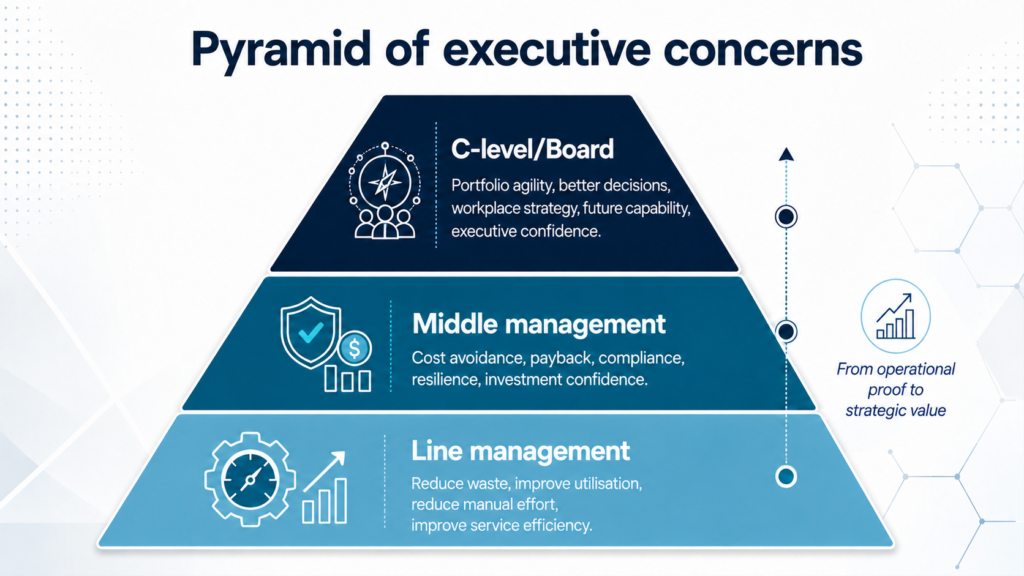
That creates a gap between what executive decision makers care about and what the investment case actually proves.
Cost reduction is valid, but it has limits
Cost reduction is often the easiest value category to defend.
It gives finance something visible. It creates a baseline. It helps justify the investment. It may also expose real inefficiencies in the current operating model.
But cost reduction has limits.
It can make the opportunity defensive. It can force the seller into a narrow return-on-investment conversation. It can invite procurement pressure because the value case is framed mainly as savings against price. It can also reduce senior executive interest if the initiative appears to be about facilities efficiency rather than broader business performance.
A cost-reduction business case asks:
What can we remove, or what can we avoid?
That is useful, but incomplete.
A value-creating business case, on the other hand, asks:
What can the organisation now do better?
Revenue gains rarely appear in iWMS
In some enterprise software categories, the value case can connect directly to revenue growth. A CRM business case, for example, can often be tied to increasing sales.
That is harder in iWMS.
An iWMS solution may improve workplace experience, portfolio agility, asset visibility, operational resilience, sustainability performance, service quality, and executive decision-making. These outcomes can matter greatly to the organisation, but they do not always translate cleanly into a direct revenue line.
There are exceptions. An iWMS Capital Projects capability, for example, may help a retailer roll out new stores or store upgrades faster and more consistently. That can improve customer experience, increase store footprint, and support revenue growth.
But for most iWMS opportunities, revenue value is not the easiest or most credible starting point.
That creates a commercial problem.
If sellers cannot credibly frame the value as revenue growth, they often fall back on cost reduction. The business case becomes easier to quantify, but less strategic.
The issue is not that sellers are wrong to include cost reduction. The issue is that cost reduction alone can understate the value of the initiative and fail to connect clearly enough to the executive transformation agenda.
The missing layer: High-Value Opportunities
The answer is not to force weak revenue claims into the business case.
The answer is to identify a broader layer of strategic high-value opportunities.
These are not direct revenue increase opportunities, and neither are they “intangible” benefits. High Value Opportunities in iWMS should be understood as future value enabled by stronger operational capability.
Examples may include better portfolio decisions, improved capital planning, more responsive workplace strategy, faster scenario modelling, stronger sustainability reporting, improved service performance, better employee experience, greater operational resilience, and more confident executive decision-making.
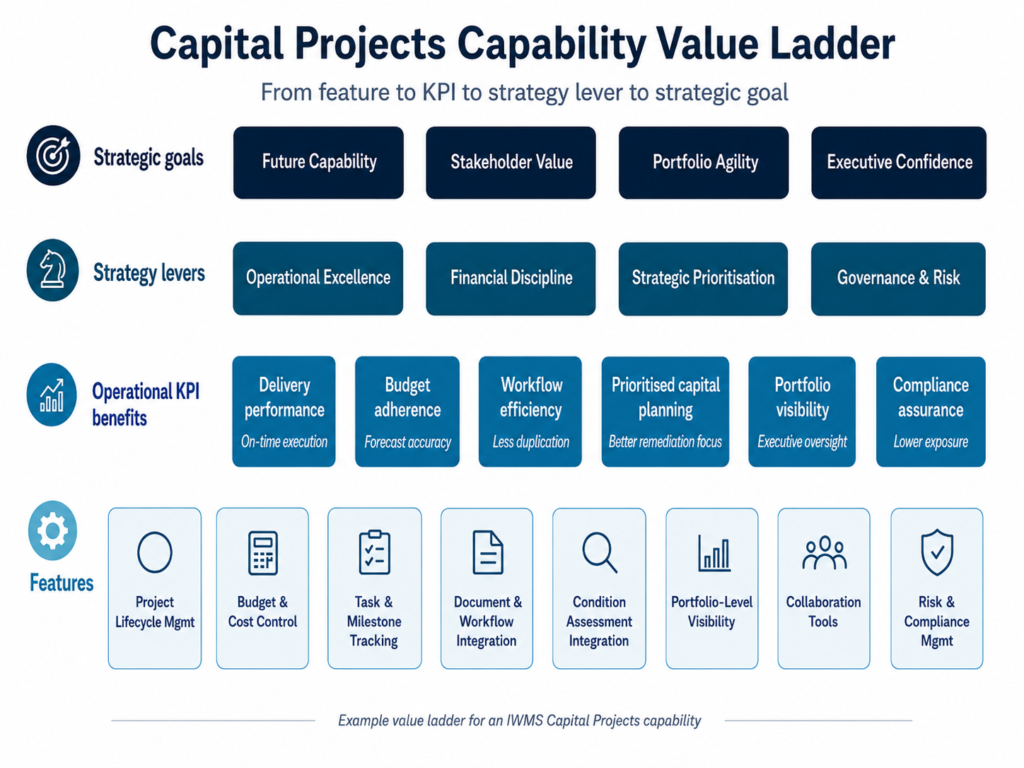
These opportunities may not show up as immediate cost savings. But they are material to the business case.
They help answer a different question:
What strategic value can the organisation create, protect, or enable through better and more agile workplace, facilities, real estate, asset, and operational intelligence?
A business case needs both HCI and HVO
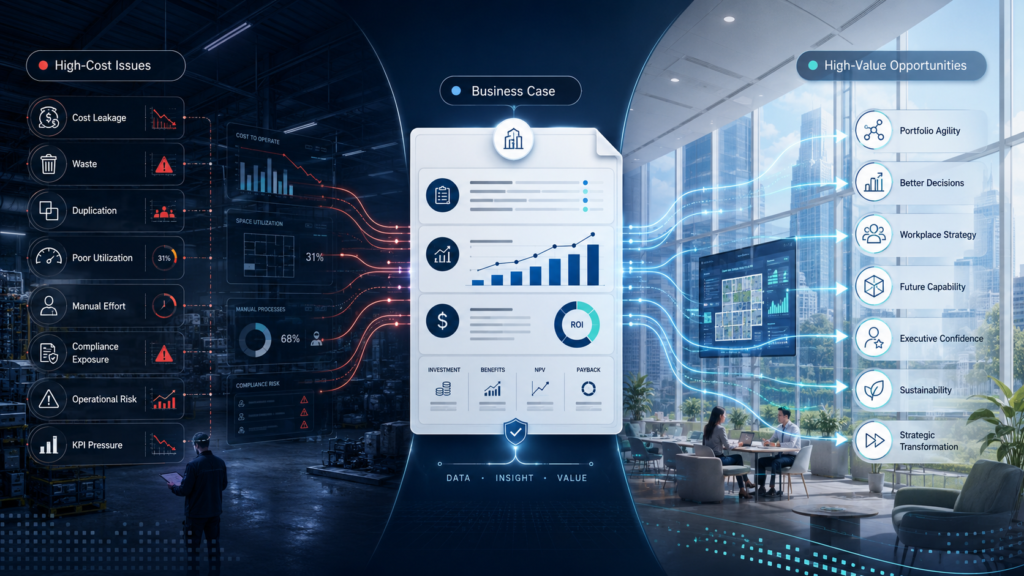
At Avvate, we separate this into High-Cost Issues (HCI) and High-Value Opportunities (HVO).
High-Cost Issues identify where value is leaking today.
High-Cost Issues usually support the operational and financial case. They help the business case speak to CFO priorities, KPI improvement, risk reduction, and operational discipline.
High-Value Opportunities identify where better decisions, capabilities, or operating models can create value.
High-Value Opportunities support the strategic case. They show how the organisation can become better able to execute strategy, improve decision quality, increase resilience, adapt its operating model, and create future value.
High-Cost Issues strengthen the CFO and KPI case.
High-Value Opportunities strengthen the executive and strategic transformation case.
A credible iWMS business case needs both.
Without High-Cost Issues, the business case may lack urgency.
Without High-Value Opportunities, the business case may lack the strategic value executive decision makers care about.
What iWMS sellers should do differently
iWMS sellers need to be careful not to collapse the value conversation into savings too early.
They need to identify cost-reduction opportunities. And they also need to ask broader value questions.
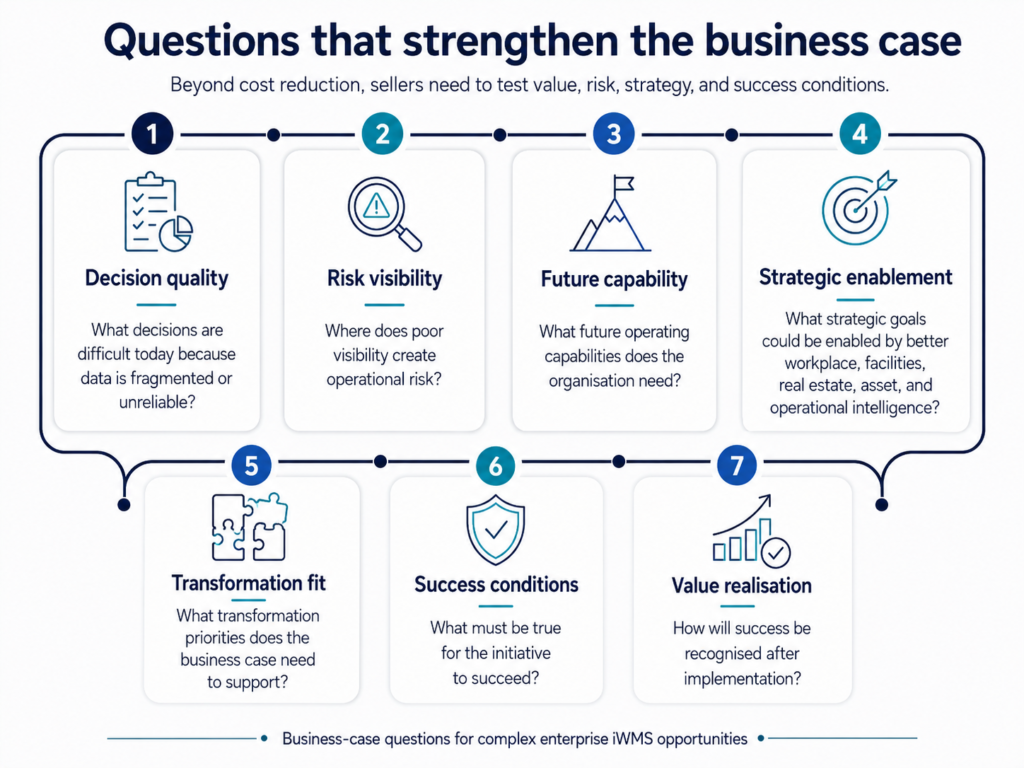
These questions change the business case.
They move the conversation from software justification to value logic.
They also help the customer see iWMS not only as a system for controlling cost, but as a platform for improving the quality of operational and strategic decisions.
The challenge for iWMS sellers is clear
Cost reduction will remain part of the iWMS business case. It must.
But if the business case stops at cost reduction, the opportunity may be under-positioned, under-valued, and easier to defer.
A stronger iWMS business case should not answer only:
What cost can we remove?
It should also answer a more strategic question:
What high-value opportunities can iWMS enable for the organisation?
That means identifying how better workplace, facilities, real estate, asset, and operational intelligence can support stronger decisions, future capability, operational resilience, executive confidence, and strategic transformation.
That is the difference between a cost-saving business case and a strategic value business case.
About ASAP
ASAP is the Avvate Sales Acceleration Programme for enterprise iWMS vendors, partners, resellers, and customer-facing teams.
It is designed for organisations operating in complex iWMS selling environments where opportunities are long-cycle, multi-stakeholder, value-dependent, and closely tied to operational transformation.
ASAP helps iWMS sellers strengthen the commercial capabilities needed to build stronger value cases, align stakeholders, improve opportunity discipline, and progress complex enterprise opportunities with clearer business logic.
The ASAP program includes:
- Applied Value Engineering where sellers learn how to build credible and compelling business cases using High Cost issues and High Value Opportunities while working with their specific solutions and customer cases.
- Enterprise Sales Consulting, where sellers learn the Diagnostic Business Development process, informed by structured consulting-style diagnostic methods, to systematically discover how the iWMS solution maps to the customer’s strategic goals.