

Getting Started With Ecosystem Intelligence

Why this matters:
A previous article (It’s Time to Rethink the Channel Partner Operating Model) argued that the channel partner operating model needs to evolve toward ecosystem intelligence.
But that raises a practical question:
How do vendors get their partner network engaged in this new discipline without friction and administrative burden?
This article intends to answer that question, and also offer guidance on getting started.
The Conditions for Ecosystem Intelligence to Work
The Best System Feels Like No System
Many vendors struggle to get useful information from their partner network, but that’s not always because partners are unwilling. Often, the operating model is just wrong or outdated.
An intelligent ecosystem cannot be built by making partners feed yet another system. It has to be designed so that useful intelligence is captured naturally through the work partners already do.
That may sound counterintuitive, but it matters. If the intelligent ecosystem is experienced as another portal, another CRM process, another reporting template, or another vendor compliance activity, adoption will be weak.
Partners should not feel that they are being asked to work for the vendor’s data strategy.
They should feel that the ecosystem helps them win better opportunities, build stronger business cases, reduce risk, improve delivery, and serve customers with more confidence.
That means intelligence capture needs to be embedded into natural workflows.
Useful signals can be captured during opportunity reviews, value case development, proposal support, implementation-readiness checks, project retrospectives, support pattern analysis, customer success reviews, and partner-vendor field discussions.
The partner should not have to stop working in order to “feed the system”.
The ecosystem should learn from the work, and the system itself should evolve to meet changing needs and preferences.
Intelligence Must Flow Both Ways
A one-way intelligence system will fail.
If the vendor collects partner insight but gives little back, partners will eventually see the system as extraction. They will be asked to contribute experience, customer knowledge, field observations, and delivery lessons, while the value accumulates somewhere else.
That is not sustainable.
An intelligent ecosystem must be reciprocal.
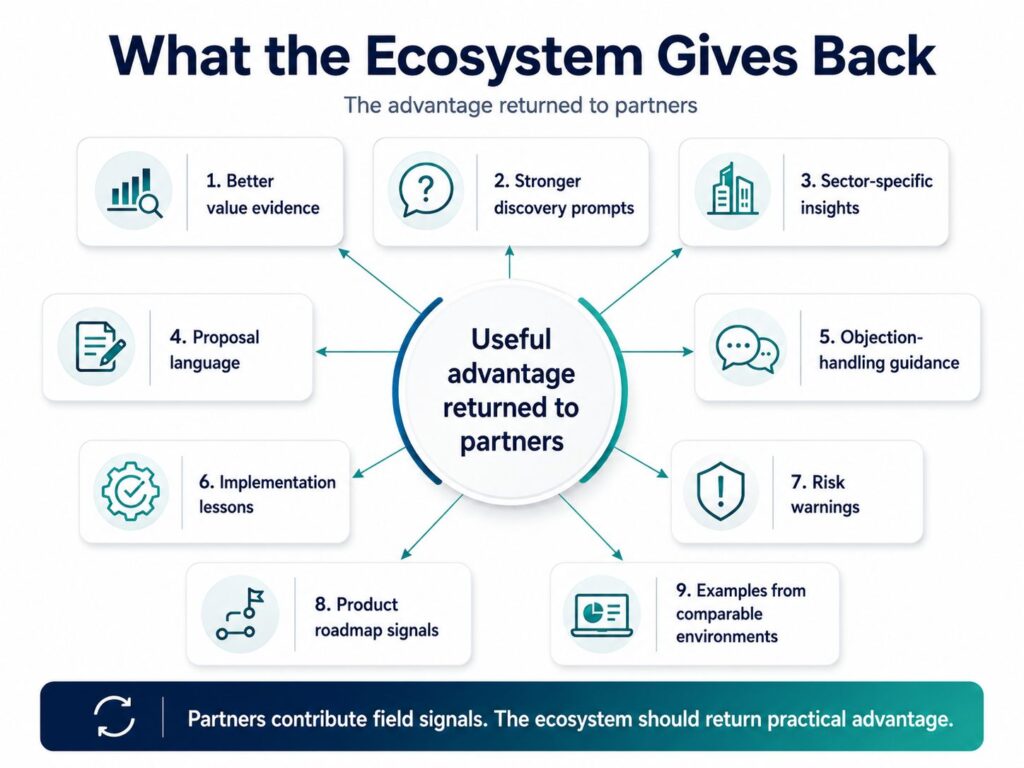
Partners contribute field signals – the ecosystem returns useful advantage.
That advantage might include better value evidence, stronger discovery prompts, sector-specific insights, proposal language, objection-handling guidance, implementation lessons, risk warnings, product roadmap signals, or examples of what has worked in comparable customer environments.
If intelligence disappears into a six-month analysis cycle, it will not change partner behaviour. But when partners see that field evidence can quickly become better guidance, better tools, better proof points, and better support, they have a reason to participate.
The principle is simple:
No latency. No black hole.
Partners Need to Experience Value Early
The intelligent ecosystem should raise partner performance from Day 1.
It should help partners understand customer issues more clearly. It should help them use stronger value evidence. It should help them avoid known risks. It should help them position the solution more credibly. It should give them access to patterns from the wider field that they could not build alone.
In other words, the system should not begin with the message:
“Give us more information.”
It should begin with:
“Here is intelligence that helps you perform better.”
Once partners experience that benefit, deeper participation becomes more natural.
What Does It Look Like in Practice?
Getting the partner network ready for ecosystem intelligence requires more than technology.
It requires three connected layers: skills, platform and workflow, and operating model.
Skills
Partners need to know what useful field intelligence looks like.
Not every customer comment is strategic intelligence. Not every objection is a market signal. Not every product request should become a roadmap priority. Not every implementation issue is evidence of a systemic problem.
Partners need the skills to recognise what matters.
They need to understand how to identify customer problems, value evidence, buying friction, stakeholder concerns, readiness risks, implementation patterns, and product feedback in a way that can be reused by the wider ecosystem.
This is not traditional product training.
It is field judgement.
Platform and Workflow
The platform layer should reduce friction, not create it.
It should help capture intelligence through normal workflows, not force partners into a separate administrative process. It should make useful guidance easy to retrieve. It should help partners find relevant evidence, patterns, and examples when they need them.
The platform should also support structure.
Without structure, the ecosystem produces noise. With too much structure, partners resist capture. The right platform balances ease of use with enough discipline to make the intelligence reusable.
AI can help here, but only if it is embedded into the workflow.
AI should help summarise, classify, connect, and retrieve useful signals. It should not become another tool partners must maintain.
Operating Model
The first principle of the operating model is that it covers the entire customer journey, from awareness of the problem and solution, through to evaluation, decision, implementation, and continuing into ownership.
The signals that matter come from every step of that journey.
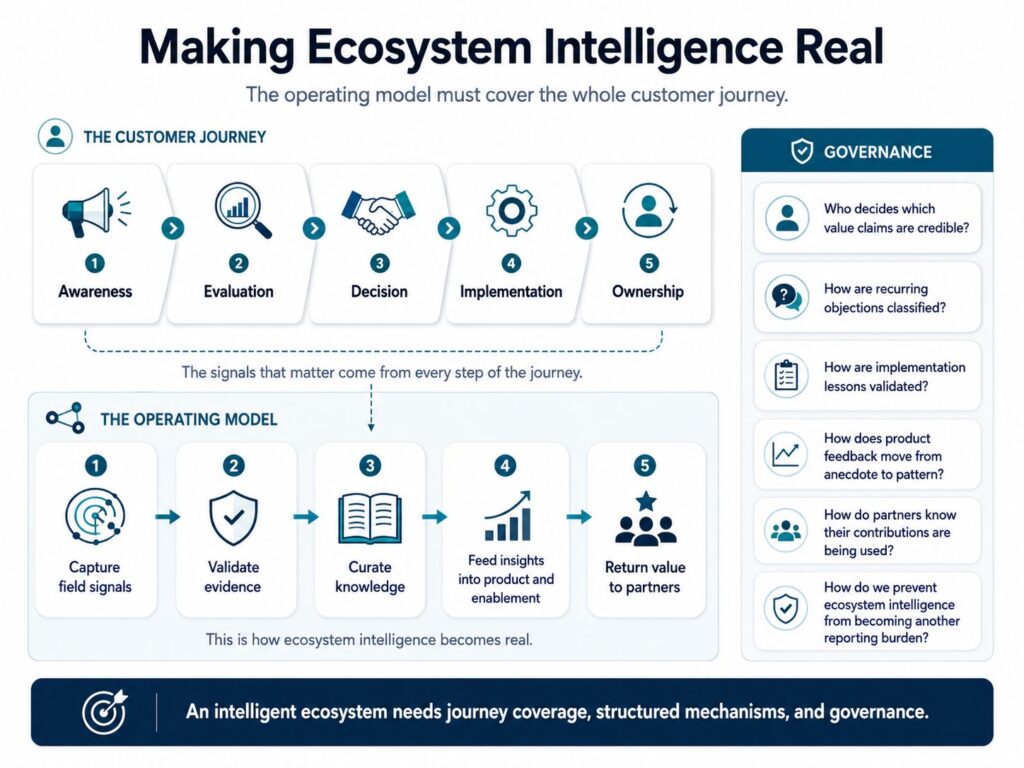
The operating model determines how ecosystem intelligence becomes real.
The vendor needs clear mechanisms for capturing field signals, validating evidence, curating knowledge, feeding insights into product and enablement, and returning value to partners.
The Readiness Conditions for ecosystem intelligence
These are the conditions that make participation useful, trusted, and easy for vendors and their partners.
1. A Common Language
Partners and vendors need shared definitions for customer problems, value promises, objections, risks, readiness issues, product feedback, and outcomes.
Without a common language, ecosystem intelligence becomes inconsistent. One partner’s “objection” may be another partner’s “risk signal”. One customer story may be treated as proof when it is really only an anecdote. One implementation lesson may be useful in a specific context, but misleading if applied too broadly.
Common language gives the ecosystem a shared way to describe what is happening in the field.
2. Low-Friction Capture
Useful intelligence should be captured through the work partners already do.
That means opportunity development, proposal support, value case development, implementation-readiness checks, customer success reviews, project retrospectives, and partner-vendor field discussions.
If partners have to stop working in order to feed a separate reporting process, participation will weaken. The system should learn from the work, not interrupt it.
3. Evidence Validation
Not every claim should become a value promise.
Not every field story is reusable evidence. Not every objection is a market trend. Not every product request should become a roadmap priority.
The ecosystem needs a way to separate opinion, anecdote, repeated pattern, and validated proof. This is what makes intelligence credible enough to reuse across partners, opportunities, sectors, and customer conversations.
4. Fast Feedback Loops
Partners need to see what comes back.
If field signals disappear into a long internal review cycle, the ecosystem will feel extractive. Partners may contribute once, but they will not build new habits around the process.
Fast feedback loops turn contribution into visible value. Partner input should become better guidance, better proof points, stronger discovery prompts, sharper objection handling, clearer risk warnings, and more useful enablement.
No latency. No black hole.
5. A Clear Value Exchange
Partners need to understand why participation benefits them.
The value exchange cannot be framed as “give the vendor more data”. It needs to help partners win better opportunities, build stronger business cases, reduce delivery risk, improve customer confidence, and grow accounts more effectively.
When partners experience useful intelligence coming back to them, contribution becomes part of performance improvement rather than administration.
6. Recognition Without Surveillance
Vendors should recognise useful contribution, but avoid turning ecosystem intelligence into compliance monitoring.
Partners should not feel exposed because they did not submit enough information, used the wrong form, or failed to meet an arbitrary contribution target.
The aim is ecosystem learning, not partner surveillance.
Recognition should encourage better field judgement, stronger evidence contribution, and shared learning across the ecosystem. It should not create another reporting burden.
AI Helps, But It Does Not Solve Readiness
AI can make ecosystem intelligence faster and more practical.
It can help summarise partner conversations, detect recurring objections, classify customer issues, compare value evidence, identify product friction, and retrieve relevant examples from the wider field.
But AI cannot fix low trust. And it cannot:
- Compensate for unclear language.
- Make partners care if the system gives them nothing back.
- Turn poor-quality signals into strong market intelligence.
- Replace the need for a partner operating model that is designed around value exchange.
This is why vendors should be careful not to lead with AI.
The more important question is not:
What AI tool should we add to the partner ecosystem?
It is:
What partner experience are we trying to create?
If the answer is “more reporting”, AI will only amplify the old problem.
If the answer is “better field support, better evidence, better learning, and better ecosystem response”, AI can become useful.
Getting Started With Ecosystem Intelligence
An intelligent ecosystem does not begin with a dashboard. Or with an AI tool.
It does not begin by asking partners to submit more information.
It begins with vision
Vendors and their partners need a shared view of what ecosystem intelligence is for.
It is not another reporting layer, or a compliance exercise, or a way to monitor individual contribution.
It is a way to turn field experience into better performance across the ecosystem.
And that requires alignment
Business partners need to trust that the system will not be used against them. They need the skills and tools to recognise useful field signals. They need low-friction ways to contribute. They need rapid value returned to them. And they need an operating model that converts field experience into useful guidance, evidence, product insight, and customer support.
And then value follows
The ecosystem also needs to recognise the value that shared intelligence can create.
This is not only about winning more deals. Ecosystem intelligence can help vendors and partners win better, deliver better, support customers better, improve the product, and build more durable customer relationships.
That makes for a different kind of competitive advantage.
Many competitive advantages are narrow. They help a vendor win in one area, for a limited time. But ecosystem intelligence has the potential to compound that advantage across the customer lifecycle: from early market understanding, through opportunity development and implementation, into adoption, expansion, retention, and product improvement.
The strongest ecosystems will not be the ones that collect the most data.
They will be the ones that make participation simple, make contribution natural, and make value flow quickly in both directions.
The best intelligence system may be the one partners barely notice. Not because it is invisible, but because it is low-friction and useful. It does not ask them to feed another process. It gives them better guidance, stronger evidence, sharper judgement, and greater confidence from the start.
And when that happens, customers experience the difference too: clearer decisions, lower risk, and greater confidence that the promised outcomes can actually be achieved.
About ASAP
ASAP helps iWMS vendors, resellers, integrators, and business partners build the field disciplines needed for ecosystem readiness.
It strengthens discovery, value framing, stakeholder alignment, business case development, forecasting confidence, proposal support, and implementation readiness.
In the context of ecosystem intelligence, ASAP can help partners generate clearer field signals while also helping vendors return more useful guidance, evidence, and support back into the partner network.