

It’s Time to Rethink the Channel Partner Operating Model
The Rise of Ecosystem Intelligence
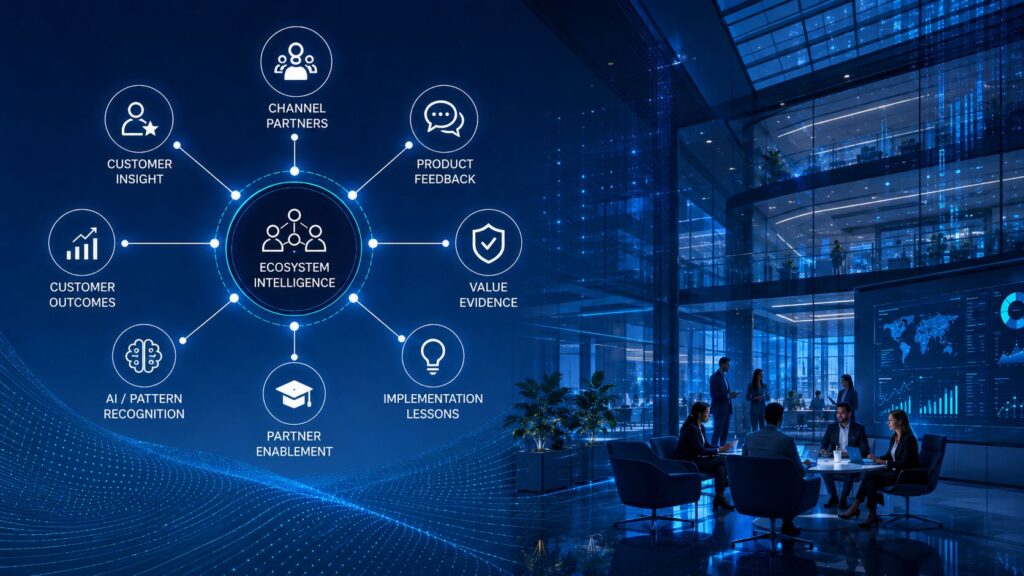
Why this matters:
The channel partner model is not obsolete. But the traditional channel partner operating model is becoming too narrow for complex enterprise markets.
For years, vendors have managed partner ecosystems through familiar measures: revenue contribution, certification levels, market coverage, implementation capacity, and customer satisfaction. Those measures still matter. They show whether a partner can sell, deliver, support customers, and extend the vendor’s reach.
But they do not tell executives enough about how the market is changing.
That is the gap that ecosystem intelligence is designed to close.
About Ecosystem Intelligence
Ecosystem intelligence is the vendor’s ability to turn field experience into market leadership by capturing, validating, and reusing signals from partners, customers, implementations, value evidence, product feedback, and outcomes.
Channel intelligence helps vendors manage partner activity.
Ecosystem intelligence helps vendors turn field insights into market leadership.
From Market Coverage to Market Insight
For years enterprise technology vendors have been building partner networks to extend their reach and delivery capacity. Partners gave them access to more markets, more customers, more local relationships, more implementation resources, and more industry knowledge.
The qualifying question was practical:
Can this partner sell, implement, and support our solution?
And that question remains relevant, but for today’s complex enterprise markets it is no longer sufficient.
Enterprise customers are under pressure to justify investment, manage risk, align stakeholders, and prove business value. Many buying processes now involve multiple functions, unclear ownership, competing priorities, financial scrutiny, implementation risk, and long-term adoption concerns.
In that environment, the vendor needs more than channel reach. It needs structured intelligence from the field to answer the big questions.
The new questions are not only about coverage and capacity. They are about market movement: which customer problems are becoming urgent, which value claims are standing up under scrutiny, which objections are increasing, where implementation risk is recurring, and which solution patterns are becoming repeatable.
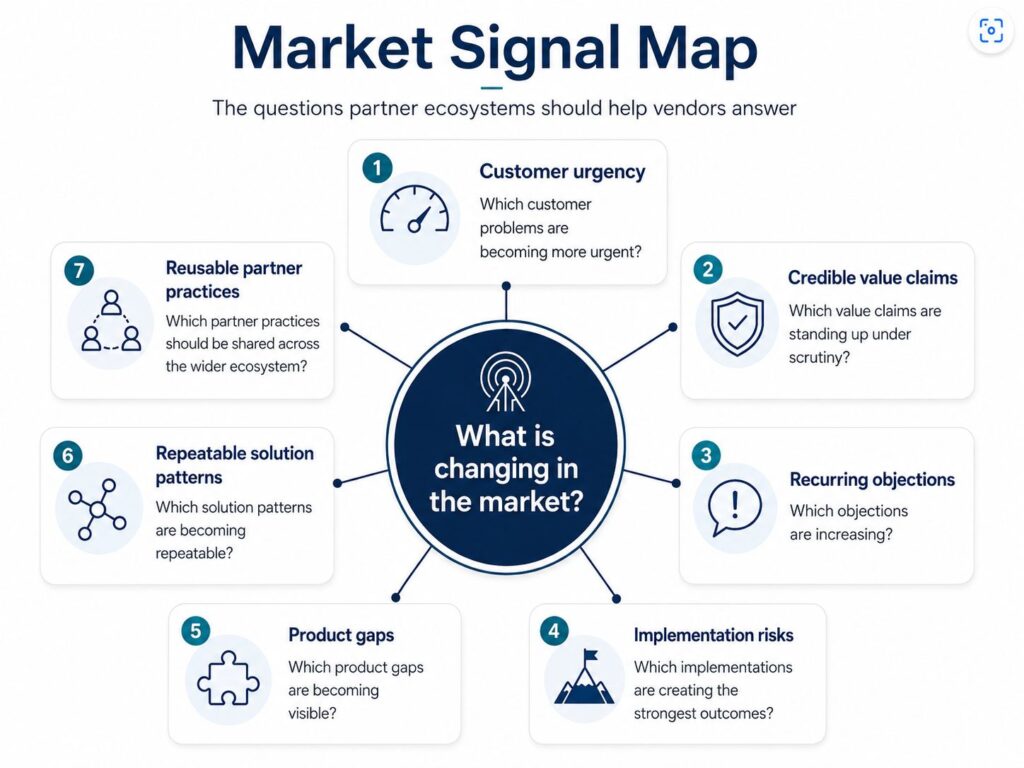
These questions change the purpose of the ecosystem.
The partner ecosystem is no longer only a route to market. It is also a way for the vendor to understand the market through shifts and over time.
What Ecosystem Intelligence Means in Practice
Ecosystem intelligence is not simply ad-hoc partner reporting.
Ecosystem intelligence is the discipline of understanding what the market is saying through the activities and experiences of the ecosystem.
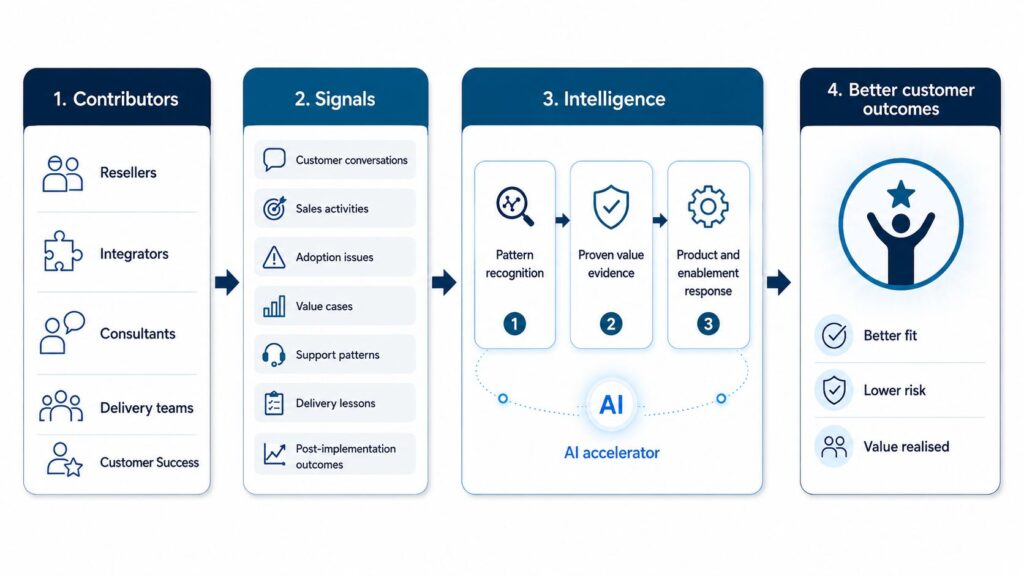
The value lies not in collecting more signals, but in separating signal from noise and detecting patterns that matter.
An intelligent ecosystem can help the vendor see how customer priorities are changing, which value points are becoming more credible, where products need to improve, where partners are seeing friction, and which practices are producing stronger customer outcomes.
A mature ecosystem does not only distribute the vendor’s product.
It helps the vendor understand, shape, and lead the market.
AI is a Catalyst, Not the Intelligence System
AI makes ecosystem intelligence more practical. It also makes the issue more urgent.
Historically, much of the useful knowledge inside a partner ecosystem was fragmented. It lived in partner conversations, sales notes, implementation lessons, customer anecdotes, support tickets, QBRs, enablement sessions, and individual experience.
Some of that knowledge reached the vendor. Most of it did not. And even when it did, it was often too slow, too anecdotal, or too difficult to interpret at scale.
AI changes that.
With the help of AI, vendors can identify patterns across large volumes of ecosystem signal. AI can summarise field feedback, detect recurring objections, compare customer issues across sectors, surface emerging value themes, identify product friction, and convert scattered partner experience into structured knowledge.
Intelligence does not start with AI. It starts with the ecosystem.
Without partner experience, customer evidence, implementation lessons, product feedback, and field observation, AI has little strategic substance to work with. It may process information fast, but the quality of the intelligence depends on the quality of the ecosystem signals.
AI does not replace partner expertise. It helps the ecosystem learn faster from that expertise.
In an AI-enabled ecosystem, the advantage is not simply having more data. The advantage is being able to learn and respond faster than competitors.
What Vendors Gain
Sales activity, forecasts, partner revenue reports, and Net Promoter Scores show what the ecosystem is doing. They do not show how the market is thinking or moving.
But ecosystem intelligence gives vendors a different level of visibility. It helps them understand which customer problems are appearing more frequently, which industries are showing urgency, which objections are becoming more common, which capabilities are misunderstood, which integrations are repeatedly requested, and which partner practices are producing stronger outcomes.
That visibility can improve partner investment decisions, enablement priorities, roadmap input, value messaging, and executive confidence in the channel strategy.
The vendor gains a live view of market movement, not just a quarterly view of channel performance.
What Business Partners Gain
Business partners benefit from ecosystem intelligence because it gives them access to a wider body of knowledge than any individual organisation could build alone.
Most partners only see their own deals, their own customers, their own implementation issues, and their own local market patterns. That insight is valuable, but limited.
A stronger ecosystem changes that.
When one vendor captures and curates intelligence from the field, all partners benefit from the patterns that emerge. They can see which customer problems are appearing most often, which objections are increasing, which implementation risks are recurring, and which practices are producing stronger outcomes.
Most importantly for business case development, they know with greater confidence which value promise points are credible, measured, and proven.
This matters because enterprise customers are increasingly sceptical of broad claims. They do not simply want to hear that a solution will improve efficiency, reduce cost, increase visibility, support better decisions, or improve operational control. They want to know “how much” and whether those claims are realistic in their environment.
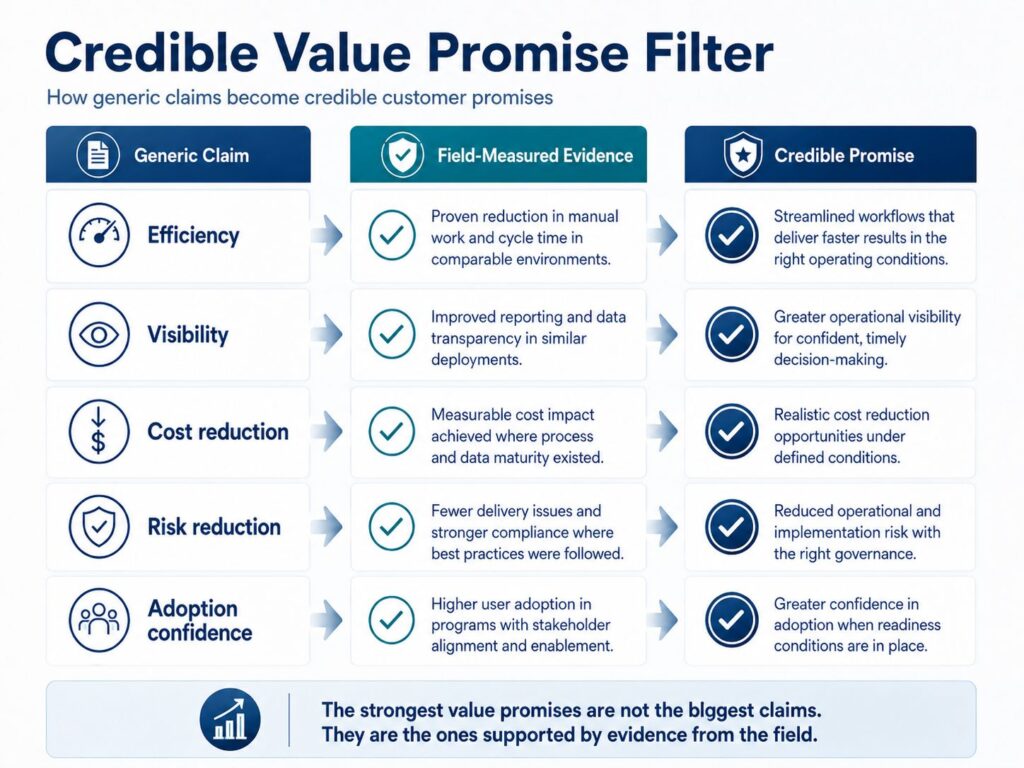
Over time, this creates a growing body of ecosystem knowledge. Partners contribute their field experience back into the system, and the wider partner network benefits from that learning. Newer or less mature partners do not need to rediscover every lesson alone.
That raises the capability level of the entire partner network.
What Customers Gain
Customers benefit when they are served by a stronger collective gene pool of seller expertise. The result should be a better buying and delivery experience.
When customers are served by a partner supported by wider ecosystem intelligence, the buying and delivery team can anticipate common risks, draw on better evidence, and avoid mistakes already seen elsewhere. They can understand which value promises have been tested and which claims remain conditional.
This can improve solution fit, reduce risk, sharpen the business case, and create more confidence in the path from decision to outcome.
It can also reduce the amount of reinvention that happens in enterprise buying. Customers should not have to rely on every partner rediscovering the same lessons one project at a time. A mature ecosystem should carry forward what has already been learned elsewhere, adapt it to the customer’s context, and make that learning useful.
That is one of the clearest customer advantages of ecosystem intelligence: access to accumulated field knowledge, not just individual partner experience.
How Products and Solutions Improve
Business partners are closest to the practical realities of the customer environment. They see where the product is strong. They also see where customers hesitate, where implementation becomes harder than expected, where workflows are unclear, where integrations are missing, where reporting falls short, and where the vendor’s assumptions do not match operational reality.
If those signals are captured properly, they become valuable product input.
They can influence roadmap decisions. They can shape vertical solution development. They can improve packaging. They can inform implementation templates. They can strengthen training. They can highlight which integrations matter most. They can reveal where customers are asking for capabilities the vendor has not yet prioritised.
AI can help product managers and solution teams separate value-adding feature ideas from recurring feature request patterns. It can show where implementation friction or usage stats point to the need for product changes. It can help prioritise high business value features that drive sales opportunities from “nice to have” cosmetic features that don’t add differentiation and competitive advantage.
The strategic value that ecosystem intelligence brings to product management isn’t “more features” – it’s features that make a difference.
That is how Ecosystem intelligence improves the product.
The Future Ecosystem Learns and Responds
The future partner ecosystem will not be judged only by its size, coverage, certifications, or implementation capacity.
Those measures will still matter. But they will not define the strongest ecosystems.
The true test will be how intelligently and how quickly the ecosystem learns and responds.
That is the shift.
| It's been about | But now it's about |
|---|---|
| Channel coverage | Ecosystem intelligence |
| Isolated partner experiences | Accumulated field knowledge |
| Generic value messaging | Proven value delivery |
| The race for product features | Field-informed product evolution |
| Slow trend emergence | Real-time insights |
The channel partner model is not dead. But the operating model needs to evolve.
For vendors in complex enterprise markets, the partner ecosystem is no longer just a route to market. It is becoming one of the vendor’s most important intelligence systems.
The advantage will go to vendors whose ecosystems learn faster, respond faster, and convert field experience into market leadership.
About ASAP
ASAP helps iWMS vendors, resellers, integrators, and business partners strengthen the field disciplines needed in complex enterprise opportunities, including discovery, value framing, stakeholder alignment, business case development, and implementation readiness.
In the context of ecosystem intelligence, ASAP helps partners generate clearer field signals and helps vendors convert partner experience into more useful market understanding.